
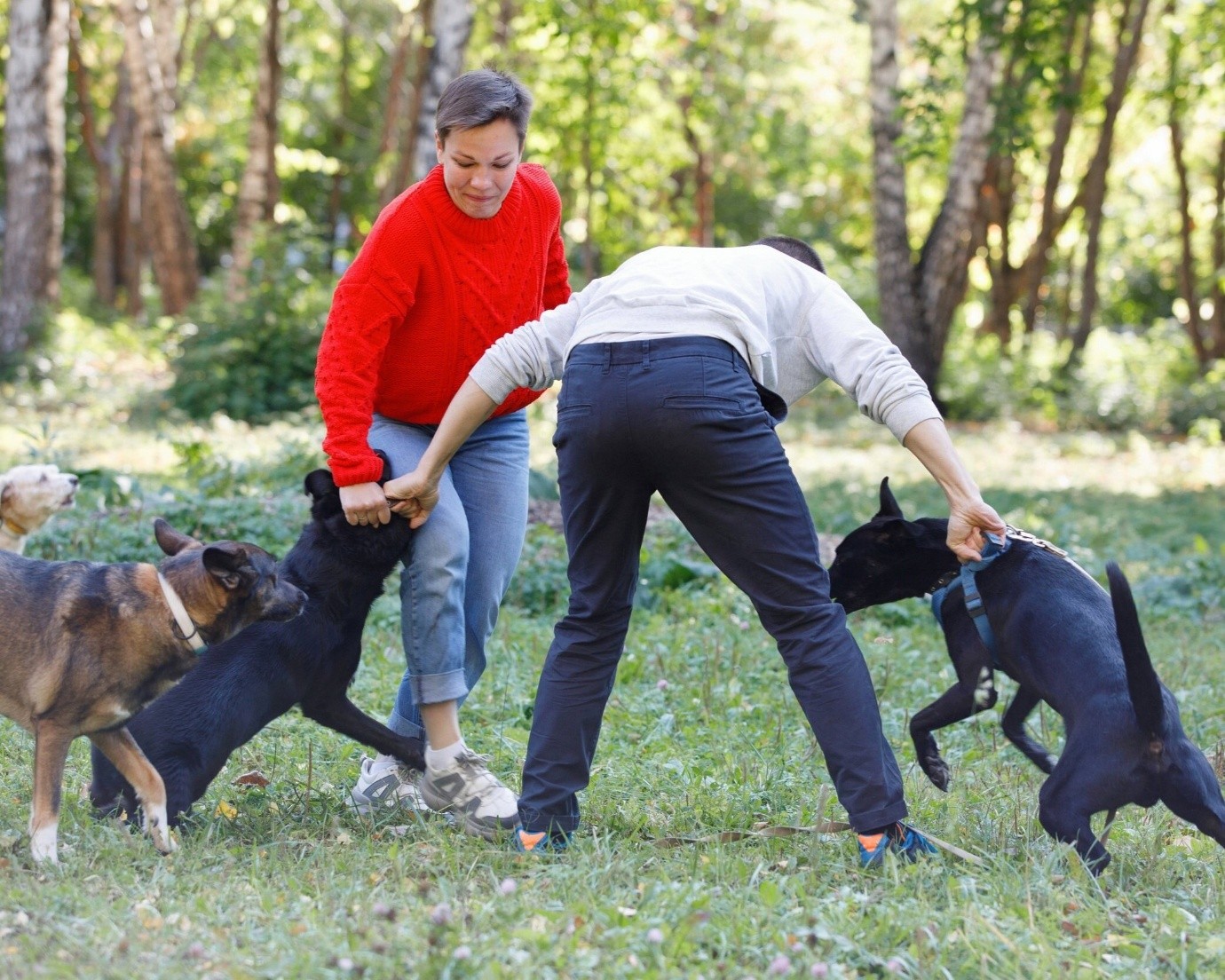
Take two dogs into the same park, and you may see completely different reactions. One trots in happily, sniffs around, and barely notices the activity. The other freezes near the entrance, pulls toward every dog it sees, or becomes so excited that its owner struggles to get its attention.
Being around other dogs is a skill in itself.
Socialization is sometimes misunderstood as simply giving dogs plenty of chances to play together. In reality, a useful social experience can be much quieter. A dog may need to learn that it can notice another animal without rushing over, remain near its owner, and move away when interaction becomes uncomfortable.
Social Does Not Mean Meeting Everyone
Imagine walking down the street with a friend. You probably do not stop and introduce yourself to every person coming in the opposite direction.
Dogs do not necessarily need to greet everyone either.
Allowing every on-leash encounter to become a meeting can actually create an expectation. The dog sees another dog and immediately assumes, “We’re going over there.”
When that does not happen, pulling, whining, or barking may follow.
Sometimes the better lesson is simply walking past. The dog notices the other animal, stays with its owner, and carries on with the day.
That is social learning too.
Start Where the Dog Can Still Think
Distance changes everything.
A dog may be perfectly capable of watching another dog from across a field but become completely overwhelmed when the distance drops to a few feet.
There is useful information in that difference.
Instead of immediately moving closer, owners can work where their dog is still able to respond. If it can look at another dog and then turn back toward its handler, that is a workable starting point.
People searching for a best rated dog trainer in austin area may want guidance on recognizing these thresholds rather than putting a dog straight into situations it cannot yet handle.
Watch the Less Obvious Signals
Not every uncomfortable dog barks.
Some turn their head away. Others suddenly become interested in sniffing the ground. A dog may move behind its owner, become unusually still, or repeatedly try to create space.
Those quieter signals are easy to miss, especially when everyone is focused on whether the dogs are playing.
Owners who become better at reading these moments can make earlier decisions. They may give the dog a break, increase the distance, or end an interaction before it becomes too intense.
Good social experiences should not depend on waiting until something goes wrong.
Controlled Practice Can Be More Useful Than Chaos
A crowded dog park may contain plenty of dogs, but that does not automatically make it the ideal classroom.
There are many moving parts. Different play styles, unknown training histories, varying levels of excitement, and owners who may have completely different expectations can make the environment difficult to control.
Structured dog socialization classes Buda TX can offer a different type of experience. The purpose is not merely to place dogs together. Controlled practice can help owners understand interaction, boundaries, and how to manage their dogs while other animals are present.
For some dogs, learning to remain calm near others is every bit as useful as direct play.
Know When Play Needs a Pause
Healthy play can look energetic. Dogs chase, wrestle, change direction, and make plenty of noise.
So how does an owner know when to interrupt?
Look at what both dogs are doing.
Are they taking turns? Does one dog pause and then choose to return? Can they separate for a moment without immediately becoming frantic?
If one animal repeatedly tries to leave while the other continues following, a break may be useful.
Short pauses also give excited dogs a chance to reset. If both want to continue afterward, play can resume.
Do Not Compare Your Dog With Somebody Else’s
The dog next door may love every animal it meets. Yours may prefer a little more space.
That is not a competition.
The practical goal is a dog that can move through everyday situations safely and with reasonable comfort; for some dogs, that includes enthusiastic play. For others, success may mean calmly passing another dog during a neighborhood walk.
Pay attention to the individual rather than chasing somebody else’s idea of the perfect social dog.
Conclusion
Good socialization is about more than increasing the number of dogs a pet meets. Owners can focus on comfortable exposure, sensible distance, appropriate interaction, and the ability to stay connected even when another dog is nearby.
Reading your dog’s body language can also help you know when to play with your dog and when to give them space. If you want to find out more about its method of dog training and owner education, visit caninemoxy.com.