
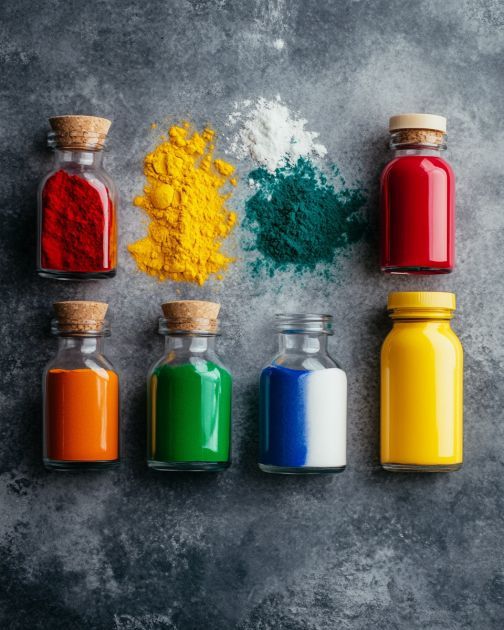
Selecting the appropriate food color is a crucial element in developing a product. The natural food coloring powder is often compared to liquid color solutions when making a decision on which of the two is better for manufacturing. Both of them offer naturally derived colors which are appealing, but each have their own benefits depending on the application.
It goes beyond the issue of appearance. Factors such as production methods, ingredient compatibility, storage duration and formulation needs all have an impact on the consistency of results. Since these are all different, it’s important to understand them so that manufacturers can choose a natural food colouring which would facilitate efficiency while maintaining product quality.
When Natural Food Coloring Powder Is the Better Choice
Natural food coloring powder is widely used due to its ease of storage, transport and measurement in the production process. Powder forms are used in many products such as dry mixes, bakery goods, seasonings, confectionery and snack foods where moisture control is significant and preferred by many manufacturers.
Another benefit is that it remains stable during storage for a longer duration under optimum conditions. Powder colors may also be mixed into dry ingredients prior to processing, which can assist in achieving an even distribution of color in the product.
Large manufacturers may prefer powdered colors because they are easy to use in their production and are easy to measure when needed to be precise with a recipe.
Advantages of Using a Natural Food Colorant in Liquid Form
The liquid natural food colorant solutions are generally chosen for those products that are already high in moisture content. Liquid colors make mixing so easy in a variety of products such as beverages, dairy products, syrups, sauces and frozen desserts.
The color dispersion has already taken place, and the color will often readily mix into formulations without any further dispersion. This can be beneficial for improved production efficiency and shortened mixing times for some applications.
Liquid colors are also found in a variety of different shades, and manufacturers can produce bright and consistent colors whilst still using naturally sourced ingredients.
Factors to Consider Before Making a Choice
This will depend on the product that’s being produced. Colors will be affected by the processing temperature, pH, moisture, shelf-life required and production equipment.
In the case of products of low water content, it might be more convenient and stable to use natural food coloring powder. Contrary to this, however, liquid formulations can usually be more convenient in applications where blending speed and uniformity of color are important.
New product manufacturers often try out both formats prior to finalizing formulations. This enables them to assess the intensity of the color, the processing speed and the final product in the actual production environment.
Working with the Right Ingredient Partner
Choosing the correct color format is made simpler by using the expertise of ingredient professionals. A well-qualified supplier can identify the best solution in response to the production needs and food use.
Support from the technical staff is especially useful when formulating new products or modifying a product recipe. Knowing the characteristics of each color format can help companies make decisions that ensure uniformity of color and production efficiency.
With the ongoing progress of natural ingredient technology, the number of powder and liquid color solutions available for a variety of food types is growing.
Conclusion
Natural food coloring powder and liquid natural food colorant have both benefits, and the selection of the one to use is dependent on your product, manufacturing process and formulation objectives. For companies seeking to investigate natural color options in a variety of food applications, they can go to foodrgb.com to find ingredients and technical know-how to help them create a successful product. The right format can help manufacturers get consistent color and boost production efficiency.