
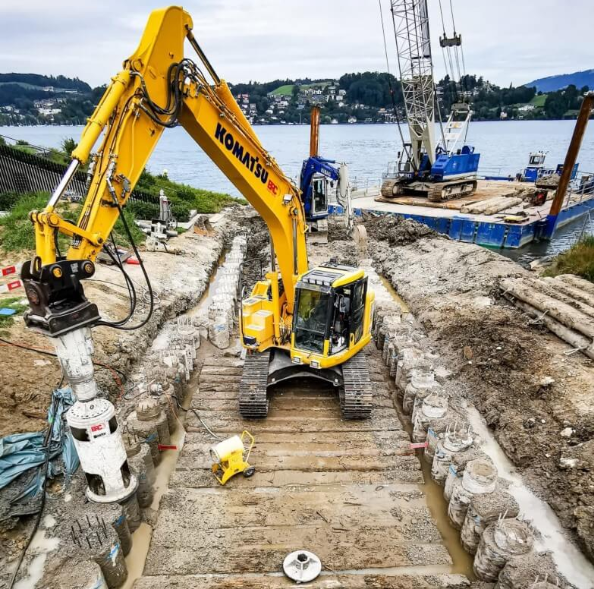
The key to a successful foundation project is working out the problem well before digging begins. Before choosing the appropriate retaining system, engineers need to assess the characteristics of the soil, groundwater, surrounding structures and expected loads on the structure. Many crews pick secant piles since they hold dirt back well when you dig down deep. Their simple setup lets you put them to use even in tight spots like transit sites, deep base digs, or crowded town builds.
Understanding The System
Crews build these walls by drilling a set of overlapping concrete posts to form a single solid barrier. The work starts with the first posts, followed by steel key posts that cut right into those first ones just enough to lock in tight.
Adjacent piles overlap to form a stable wall to counteract soil pressure in the excavation process. The final product can also be incorporated into the permanent structure, acting as a permanent load-bearing structure, depending on the project design.
Evaluating Ground Conditions
A detailed ground investigation is a first step in project planning, as every construction site has its own set of challenges. The foundation design is affected by soil type, underground water and obstructions.
Engineers review geotechnical reports prior to selecting Secant piles to check if it meets site requirements. By knowing these conditions, construction risks can be reduced, and the retaining wall will function as needed throughout the construction process.
Common Project Applications
Examination of many developments will involve excavation near buildings or public facilities. In such cases, it is important to maintain ground stability to preserve the integrity of adjacent structures and ensure construction programs are adhered to.
The most common applications of secant piles are deep basements, underground transport stations, bridge foundations, tunnels, retaining structures, industrial applications, and commercial developments. Their versatility enables them to be used in various sizes and ground conditions of the project.
Design And Construction Factors
Careful design plays an important role in the performance of any retaining system. The diameter, spacing, reinforcement and overlap of the piles are determined by the depth of excavation and the structural loading.
When installing Secant piles, it is critical to drill and position accurately to ensure that a continuous wall is installed. Well, with the modern surveying equipment and quality control in place, it will be much easier to keep the alignment and less likely to make any construction mistakes.
Long-Term Project Benefits
Durability is a critical factor in foundation system planning as its systems are expected to last for decades. A properly designed retaining wall can add to the safety of construction and stability to the structure.
The use of Secant piles can enhance the overall efficiency of a project, as they can be used to provide temporary supports for the excavation site as well as for the structure itself. They still offer a great fix for modern base work, mostly as they stop ground shifts and fit right into tricky job sites.
Conclusion
Secant piles fit deep base jobs well since they last long, go in easy, and adapt fast. They handle all sorts of site setups and give a really solid answer for many builds. The strength, flexibility and assured adhesion to the ground make them ideal for various commercial and infrastructure projects. A combination of detailed design and precise installation can ensure construction teams get long-term stable performance. For practical advice and resources on the latest in foundation technology and engineering solutions, check out Brextor.com.