Introduction
Water has been used as a healing medium for thousands of years. From ancient Roman baths to modern therapeutic pools, humans have long recognized that immersion in water does something fundamentally different to the body than any land-based treatment can replicate.
Today, water therapy — or hydrotherapy — is one of the most evidence-supported rehabilitation modalities available, and it’s gaining well-deserved attention among Vancouver’s health-conscious population. Whether you’re recovering from a joint replacement, managing arthritis, rehabbing a sports injury, or simply trying to move without pain, aquatic physiotherapy offers a path that land-based therapy sometimes can’t.
This guide covers the science behind water therapy rehab in Vancouver, the specific conditions it helps most, and what to expect when you step into the therapeutic pool.
What Is Water Therapy Rehab?
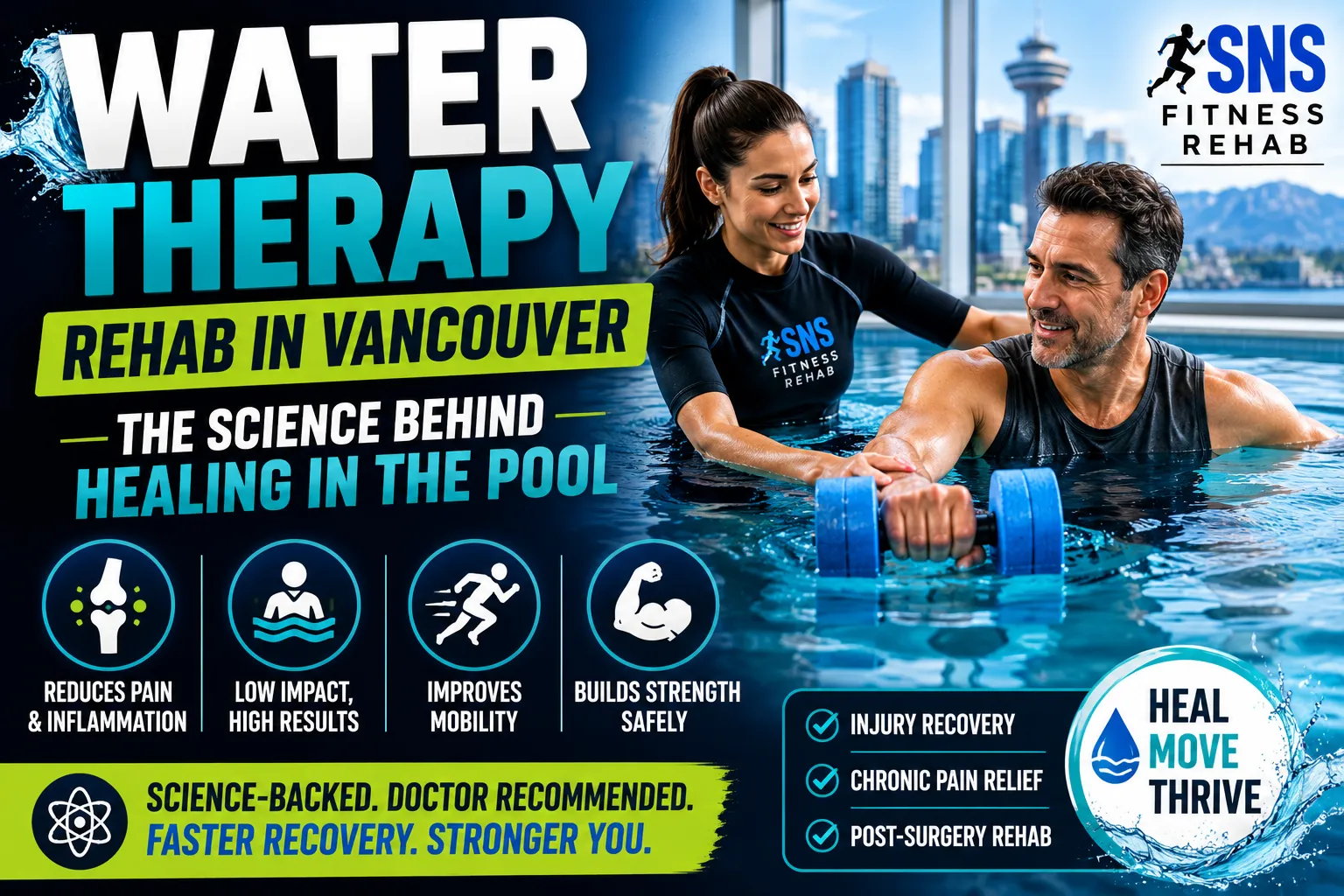
Water therapy rehab — also called aquatic physiotherapy, hydrotherapy, or pool-based rehabilitation — refers to structured therapeutic exercise and treatment delivered in a purpose-designed or heated therapeutic pool.
It’s not swimming laps or a casual water aerobics class. Aquatic physiotherapy is a clinically guided process in which the properties of water are used intentionally to achieve specific rehabilitation outcomes.
The three primary physical properties of water that make it therapeutically powerful are:
Buoyancy
When submerged to chest depth, the body is effectively offloaded of approximately 75% of its body weight. Submerged to neck depth, that figure rises to about 90%. This dramatic reduction in gravitational load allows patients to perform movements that would be impossible — or significantly painful — on land.
For someone recovering from a hip or knee replacement, or managing severe osteoarthritis, this isn’t a minor convenience. It’s the difference between being able to move therapeutically and not being able to exercise at all.
Hydrostatic Pressure
Water exerts uniform pressure on all submerged surfaces. This hydrostatic pressure has several clinically relevant effects:
-
Reduces swelling and edema around injured joints
-
Improves proprioception (your body’s sense of its own position in space)
-
Enhances cardiovascular efficiency during exercise
-
Provides a mild stabilizing effect on unstable joints
For patients with lower limb injuries, edema management through hydrostatic pressure can accelerate tissue healing and reduce the discomfort that slows land-based rehabilitation.
Viscous Resistance
Water is approximately 800 times denser than air. Movement through water provides resistance in all directions simultaneously — meaning every motion works both the prime movers and their opposing muscle groups. This multidirectional resistance is remarkably effective for building functional strength without the compressive joint loading of traditional resistance training.
Who Benefits Most From Aquatic Physiotherapy?
Water therapy rehab is particularly well-suited for a wide range of conditions and patient profiles. The common thread is that the reduced load environment of water opens therapeutic doors that would otherwise remain closed.
Post-Surgical Rehabilitation
Patients recovering from joint replacement surgeries — hip, knee, shoulder — can often begin aquatic physiotherapy much earlier than land-based strengthening, sometimes within days of receiving surgical clearance to get the wound wet. Early movement in a buoyant environment supports the neuromuscular system’s adaptation to the new joint without overloading healing tissue.
SNS Fitness Rehab’s hydrotherapy program is specifically designed to support this post-surgical population, bridging the gap between early recovery and return to land-based functional training.
Osteoarthritis and Joint Conditions
Arthritis is one of the most prevalent conditions among adults in British Columbia and across Canada. For people living with moderate-to-severe osteoarthritis in the hip, knee, or spine, land-based exercise often causes enough pain and joint stress that adherence becomes a serious problem.
Aquatic exercise for osteoarthritis is supported by a substantial body of research. A systematic review published in Cochrane Database of Systematic Reviews found that aquatic exercise had a beneficial effect on pain, function, and quality of life for people with hip and knee osteoarthritis — with the benefits comparable to land-based exercise but better tolerated by patients with higher pain levels.
Neurological Conditions
Water therapy is increasingly used in neurological rehabilitation for conditions including stroke, multiple sclerosis, Parkinson’s disease, and cerebral palsy. The warm water environment reduces spasticity, improves balance in a safer fall-risk environment, and allows repetitive movement practice that drives neuroplastic change.
Fibromyalgia and Chronic Pain
For patients with fibromyalgia or other chronic pain conditions, exercise can feel paradoxically threatening — something that should help but often triggers flares. Warm water exercise has a specific advantage here: the thermal properties of heated water reduce pain sensitivity and allow patients to move at intensities that would provoke significant discomfort on land.
Sport Injury Rehabilitation
Athletes recovering from muscle strains, stress fractures, or overuse injuries can maintain cardiovascular fitness and begin strength work through aquatic exercise while protecting the injured structure. Deep water running, for instance, allows a runner to maintain aerobic conditioning without any impact load — an invaluable tool during stress fracture recovery.
This integrates naturally with the sport-specific training approach at SNS Fitness Rehab, where aquatic conditioning is one component of a comprehensive athletic rehabilitation pathway.
What Does a Water Therapy Rehab Session Look Like?
Aquatic physiotherapy sessions are more structured and clinically directed than most people expect. Here’s a general breakdown:
Pre-session: Your physiotherapist or kinesiologist reviews your current status — pain levels, any changes since the last session, and goals for today’s session.
Warm-up: Gentle walking and mobility movements in the shallow end of the pool to prepare the body for therapeutic activity.
Core therapeutic exercises: The bulk of the session involves prescribed exercises targeting your specific rehabilitation needs. These might include:
-
Assisted range-of-motion exercises for post-surgical joints
-
Resistance-based strengthening using aquatic noodles, paddles, or water weights
-
Balance and proprioception training (standing on one leg in moving water, for example)
-
Gait retraining for patients recovering from lower limb injuries or neurological events
-
Aquatic running or walking for cardiovascular conditioning
Cool-down and review: Gentle stretching and movement, followed by discussion of progress and planning for subsequent sessions.
Sessions typically run 30–60 minutes, with frequency depending on your diagnosis, recovery stage, and overall rehabilitation plan.
Hydrotherapy vs. Land-Based Physiotherapy: Which Is Better?
Honest answer: it’s not an either/or question.
The most effective rehabilitation programs use water-based and land-based treatment as complementary tools — each with unique advantages that, when combined, produce outcomes superior to either approach alone.
|
Factor |
Aquatic Therapy |
Land-Based Therapy |
|
Joint load |
Significantly reduced |
Full weight-bearing |
|
Ideal early post-surgery |
✓ Often yes |
✓ With modification |
|
Muscle activation |
Good (with resistance tools) |
Excellent with progressive loading |
|
Proprioception training |
Excellent |
Good |
|
Cardiovascular conditioning |
Very effective |
Very effective |
|
Edema management |
Excellent |
Limited |
|
Fall risk |
Reduced |
Standard |
|
Functional transfer to daily life |
Moderate |
Higher |
At SNS Fitness Rehab, water therapy rehab is integrated within a broader rehabilitation ecosystem that includes personal training and kinesiologist-led conditioning — ensuring that gains made in the pool translate to land-based function and real-life movement.
Hydrotherapy and ICBC Rehabilitation
For clients recovering from injuries sustained in motor vehicle accidents, aquatic physiotherapy is a recognized component of active rehabilitation under ICBC coverage. The low-impact nature of hydrotherapy is particularly well-suited for whiplash-associated disorders and lower extremity injuries that are common in collision-related trauma.
If you’re navigating an ICBC claim and want to understand how water therapy might fit into your recovery, the team at SNS Fitness Rehab can help you understand your options and how hydrotherapy integrates with your broader rehabilitation plan.
The Warm Water Difference
One aspect of therapeutic aquatics that deserves its own mention is temperature. Most therapeutic pools are maintained at approximately 33–35°C — significantly warmer than a standard lap pool.
Warm water immersion at these temperatures:
-
Reduces muscle tone and spasticity
-
Relieves pain through thermal effects on sensory nerve receptors
-
Increases blood flow to peripheral tissues
-
Creates a sense of relaxation that facilitates deeper therapeutic movement
For patients who are anxious about exercise due to chronic pain or post-surgical vulnerability, the warm, supportive environment of a therapeutic pool can be psychologically as important as it is physically beneficial.
What to Bring and Expect for Your First Session
Practical logistics:
-
Bring a standard swimsuit (one-piece is generally recommended for ease of movement in therapeutic exercises)
-
A towel and change of clothes
-
Any relevant medical documentation — imaging reports, surgical notes, physiotherapy referral
-
Footwear for the pool deck (flip-flops or aqua shoes)
Expectations for the first session:
The first aquatic session is typically lighter than subsequent ones — your therapist is establishing your baseline tolerance and teaching you the exercises that will form the foundation of your program. Don’t be surprised if you feel more tired than you expect — water resistance is more demanding than it looks, and even gentle aquatic exercise engages the whole body.
Post-session fatigue is normal and typically diminishes as your body adapts to this form of exercise over the following 1–2 weeks.
FAQs
Q1: Is water therapy safe for people who can’t swim?
Yes. Aquatic physiotherapy is conducted in pools with varying depths, and most therapeutic exercises occur in the shallow end where patients can comfortably stand. Swimming ability is not required, and therapists are always present to ensure safety.
Q2: How warm is the therapeutic pool used in hydrotherapy?
Therapeutic pools are typically maintained between 33°C and 35°C — much warmer than standard lap pools. This warmth reduces muscle tension and pain sensitivity, making it easier to move therapeutically.
Q3: How soon after surgery can I start water therapy?
This varies by procedure and surgeon preference. In many cases, patients can begin aquatic physiotherapy within 2–4 weeks of surgery, once surgical incisions have healed sufficiently and the surgeon has given clearance for pool immersion. Your rehabilitation team will coordinate the appropriate timing.
Q4: Does aquatic physiotherapy help with back pain?
Yes, significantly. Water therapy is particularly effective for chronic low back pain, lumbar disc conditions, and post-spinal surgery rehabilitation. The buoyancy reduces spinal compression while the warm water relaxes the muscles that typically guard and tighten around a painful spine.
Q5: How many water therapy sessions will I need?
This depends entirely on your diagnosis and rehabilitation goals. Some patients benefit from as few as 6–8 sessions; others with complex or chronic conditions benefit from ongoing aquatic conditioning as part of a long-term management plan.
Q6: Can children participate in hydrotherapy?
Yes. Aquatic physiotherapy is well-suited for pediatric rehabilitation, particularly for children with developmental conditions, neurological diagnoses, or recovering from orthopedic procedures. The playful, low-stress environment of the pool often makes therapy more accessible for younger patients.
Q7: Is water therapy covered by extended health insurance in BC?
Coverage varies by provider and plan. Many extended health plans cover physiotherapy-directed aquatic therapy. It’s worth checking with your provider before starting — and if you’re an ICBC claimant, hydrotherapy may be covered as part of your active rehabilitation benefits.
Key Takeaways
-
Hydrotherapy uses the physical properties of water — buoyancy, hydrostatic pressure, and viscous resistance — as therapeutic tools
-
Aquatic physiotherapy is evidence-supported for osteoarthritis, post-surgical recovery, neurological conditions, chronic pain, and sport injury rehab
-
Therapeutic pools are maintained at warm temperatures that enhance tissue relaxation and pain relief
-
Water therapy works best as a complement to land-based rehabilitation — not a replacement
-
Swimming ability is not required; most therapeutic exercises occur in shallow water under clinical supervision
Conclusion
Water is a powerful rehabilitation medium — not because it’s easy, but because it removes barriers that would otherwise prevent therapeutic movement. For patients who are in pain, recently post-surgical, or managing chronic joint conditions, the pool offers something land-based therapy cannot always provide: the ability to move without fear.
Water therapy rehab in Vancouver is no longer a niche offering. It’s a clinically validated pathway to recovery that’s helping people rebuild strength, restore function, and return to the activities they love.
Ready to experience the benefits of aquatic rehabilitation? Learn more about SNS Fitness Rehab’s hydrotherapy program and take the first step toward healing in the water.